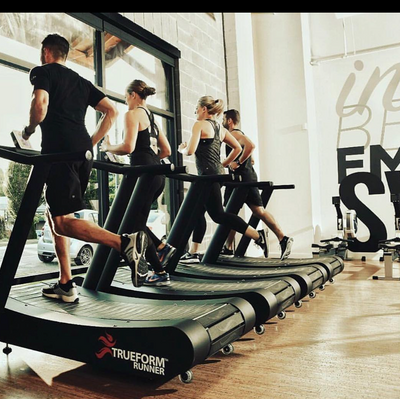
Can the TRUEFORM Runner Change the Way You Run? What the Research Found
At TRUEFORM, we’ve always believed the treadmill should do more than simply move beneath you.
It should help create a better environment for movement.
That belief is behind the way we design our products: no motor controlling the belt, no preset pace forcing the athlete to keep up, and no unnecessary technology getting between the runner and the ground beneath them.
The runner creates the movement.
Their position, foot strike, stride and application of force all influence how the treadmill responds.
That’s the theory behind what we do.
But does it actually change the way someone runs?
Researchers at the University of South Carolina Aiken set out to answer that question.
In a peer-reviewed study published in Sports, researchers Andrew Hatchett, Kaitlyn Armstrong, Brian Parr, Mallory Crews and Charlie Tant examined whether short bouts of running on a curved non-motorized treadmill (the TRUEFORM Runner) could influence measurable characteristics of running gait.

More importantly, they wanted to determine whether those changes would still be present when the runners returned to a traditional motorized treadmill.
THE STUDY
Sixteen healthy college-aged participants took part in the study.
Researchers analyzed four characteristics of running gait:
- Step length
- Stride length
- Left-to-right imbalance
- Stride angle
After familiarization and warm-up, each participant completed five four-minute running bouts.
The sequence alternated between a traditional motorized treadmill and the TRUEFORM Runner:
Motorized → TRUEFORM → Motorized → TRUEFORM → Motorized
Gait measurements were taken during each of the motorized treadmill trials.
That distinction matters.
The researchers weren't simply comparing how people ran on two different types of treadmills. They were looking at whether exposure to the TRUEFORM Runner influenced how participants ran after they stepped back onto the traditional treadmill.
And it did.
Researchers found statistically significant changes in all four gait variables following exposure to the TRUEFORM Runner.
STEP LENGTH AND STRIDE LENGTH
One of the clearest changes was a reduction in both step length and stride length.
Average step length decreased from 0.86 meters at baseline to 0.75 meters after the first TRUEFORM exposure and 0.68 meters following the second exposure.
Average stride length followed a similar pattern, decreasing from 1.89 meters to 1.65 meters and eventually 1.52 meters.
These changes were statistically significant.
Why does that matter?
Overstriding—particularly reaching too far in front of the body's center of mass—can increase braking forces and impact during running.
Previous biomechanics research has shown that reducing stride length or increasing step rate can reduce several loading characteristics, including impact peaks and loading rates.
The important takeaway isn't that every runner needs the shortest stride possible.
It's that running on the TRUEFORM appeared to encourage participants toward a more compact stride pattern—and that pattern remained when they returned to a conventional treadmill.
STRIDE ANGLE
Stride angle also changed substantially during the study.
Average stride angle began at 3.55 degrees, fell to 1.23 degrees following the first TRUEFORM bout and reached 0.47 degrees following the second exposure.
Researchers found these changes to be statistically significant.
Stride angle is one way researchers evaluate the relationship between the runner's flight phase and ground contact. Previous research has identified associations between stride angle, contact time and running economy.
The authors noted that the direction of the changes observed in the study was consistent with gait characteristics associated with improved running economy.
That doesn't mean four minutes on a TRUEFORM suddenly makes someone an economical runner.
It does suggest that the treadmill environment can rapidly influence the mechanics a runner naturally chooses.
LEFT-TO-RIGHT IMBALANCE
Researchers also found significant changes in the participants' gait asymmetry.
Following the first exposure to the TRUEFORM Runner, participants moved toward a more symmetrical running pattern.
Some of that improvement diminished during the final trial, which the researchers suggested could potentially have been related to fatigue. They also noted that additional research would be necessary to determine the cause.
Symmetry shouldn't be interpreted as a simple "more symmetry always equals fewer injuries" equation. Human movement naturally contains some degree of asymmetry.
But large differences between sides can provide useful information about how an athlete applies force and moves through the gait cycle.
The fact that short exposure to the TRUEFORM significantly influenced this measurement adds another interesting piece to the study: the treadmill wasn't simply changing speed or stride length. It was influencing multiple components of the participants' movement patterns.
THE BIGGER FINDING: THE TREADMILL BECAME THE FEEDBACK
Traditional gait retraining often relies on coaching cues, video analysis, laboratory equipment or real-time visual and auditory feedback.
The TRUEFORM study points toward another possibility:
Change the environment and the environment itself may provide the feedback.
Because the belt is powered entirely by the runner, poor positioning and inefficient force application immediately affect the way the treadmill responds.
Move too far forward.
Reach too aggressively.
Lose rhythm.
The athlete feels it.
Conversely, when the runner finds a more effective position and rhythm, the treadmill responds immediately.
That interaction may help explain why researchers observed measurable gait changes after only four-minute exposures.
And arguably the most interesting part of the study is that those changes weren't measured only while participants were on the TRUEFORM.
They were measured when the participants returned to the traditional motorized treadmill.
WHAT THE STUDY DOES — AND DOESN'T — PROVE
This was a small study involving 16 young, healthy participants.
It examined the immediate effect of short exposures to the TRUEFORM Runner. It was not a long-term training study, and it did not measure injury rates or demonstrate that every runner will develop permanently different mechanics after using the treadmill.
The researchers also identified limitations including differences in participants' footwear, treadmill experience and fitness levels.
So it would be inaccurate to say this study proves that the TRUEFORM Runner prevents injury or permanently fixes someone's running form.
What the research does show is compelling on its own:
Short bouts of running on the TRUEFORM Runner produced statistically significant changes in step length, stride length, stride angle and gait imbalance, and those changes were measurable when participants returned to a traditional motorized treadmill.
That supports an idea that has been central to TRUEFORM from the beginning:
The machine shouldn't dictate how you move. It should give you an environment that teaches you to move better.
Instead of selecting a speed and trying to keep up with a motor, the athlete creates every step.
The Runner responds.
And according to this research, even a few minutes of that interaction can change the way an athlete runs.
Study: Hatchett, A., Armstrong, K., Parr, B., Crews, M., & Tant, C. (2018). The Effect of a Curved Non-Motorized Treadmill on Running Gait Length, Imbalance and Stride Angle. Sports, 6(3), 58.